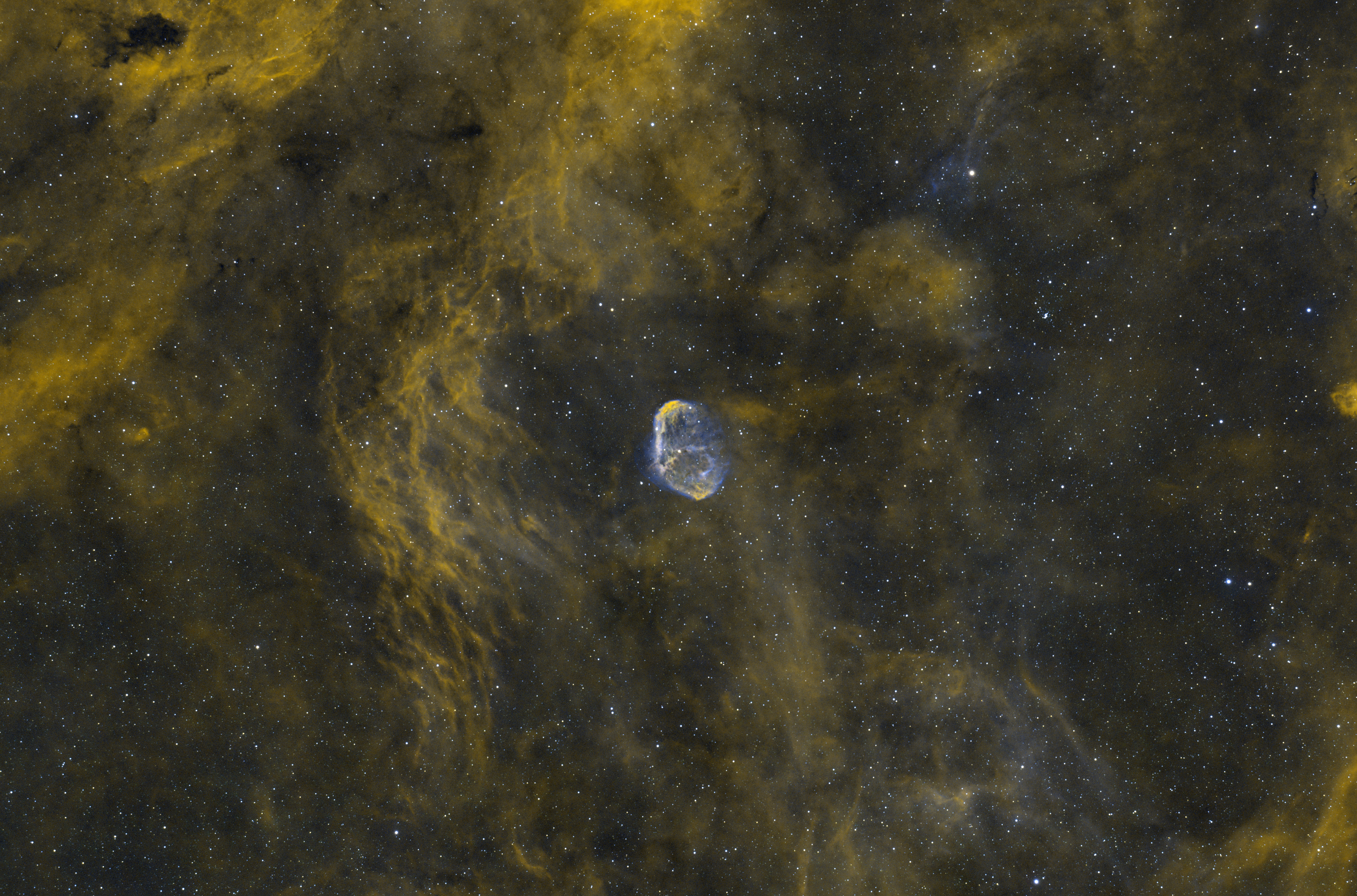
Crescent Nebula
The Crescent Nebula (NGC 6888) is located in the rich star fields of the constellation Cygnus, not far from the bright star Sadr. Spanning roughly 18 by 12 arcminutes, it is much smaller than the North America and Pelican Nebulae but still has a relatively low surface brightness. Visually, it is a challenging object that benefits from dark skies, moderate-to-large telescopes, and nebula filters such as O III or UHC to reveal its characteristic arc-shaped structure.
It is a favorite target for astrophotographers, especially when imaged through narrowband filters such as Hydrogen-alpha (Hα), Oxygen III (O III), and Sulfur II (S II). Long-exposure images reveal an intricate network of shock fronts, wispy filaments, and glowing shells of ionized gas. The contrast between the bright oxygen-rich outer arcs and the hydrogen-emitting interior produces dramatic detail that is often showcased in false-color narrowband palettes.
NGC 6888 is formed by the powerful stellar winds of the massive WR 136, a Wolf–Rayet star nearing the end of its life. Fast winds currently streaming from the star are colliding with material expelled during an earlier red supergiant phase, creating the nebula’s complex shell structure and shock waves. Astronomers study the Crescent Nebula as a nearby laboratory for understanding how massive stars shape their surroundings and enrich interstellar space with heavy elements. In a few hundred thousand years, WR 136 is expected to end its life in a supernova explosion, dramatically altering the nebula and leaving behind a structure very different from the Crescent Nebula we observe today.
You can also download the full size high resolution image . Download (99 MB)
The image was processed using Siril for a one night (3h) session stacking and followed the post-processing guidelines for dual narrowband filters video.