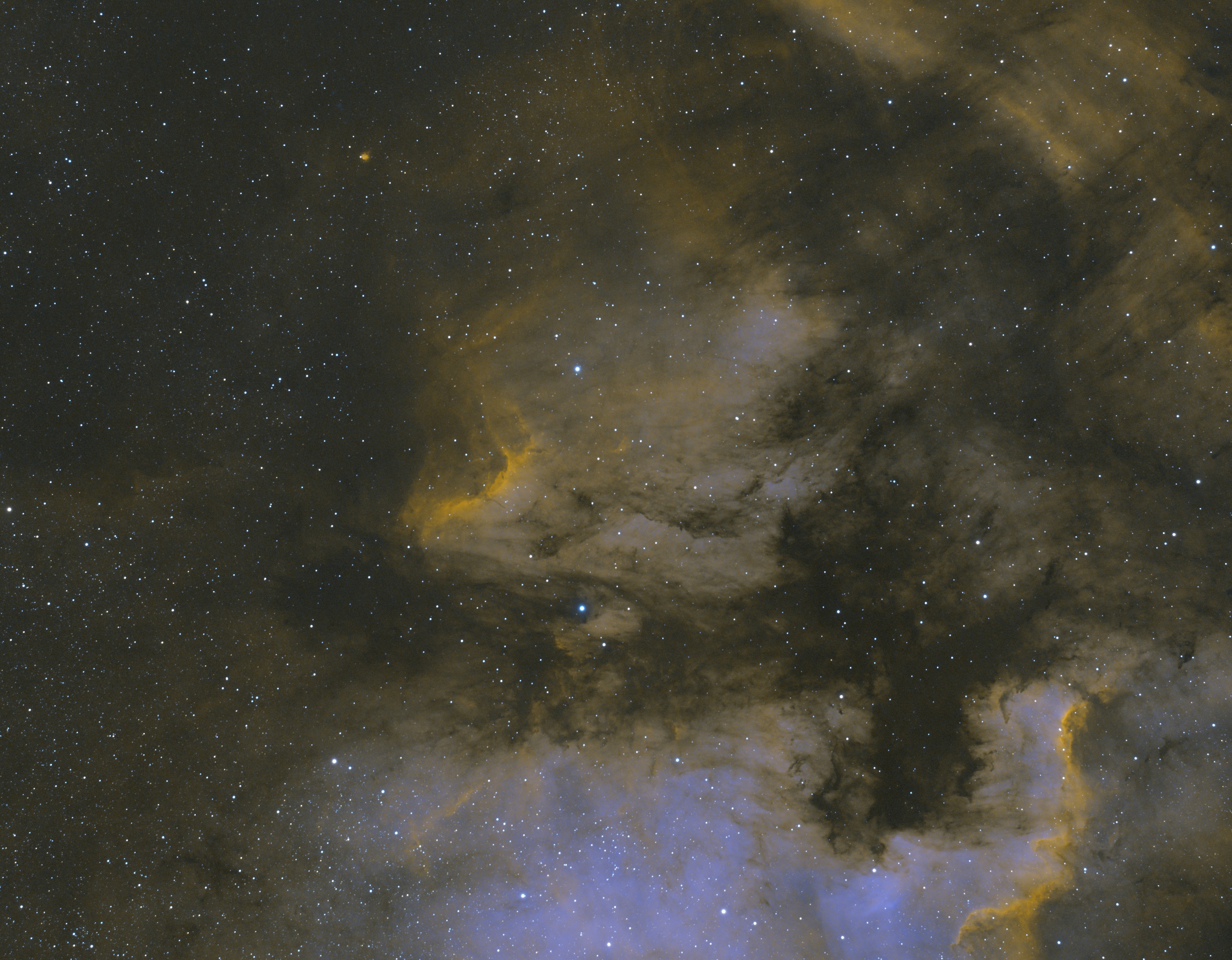
Pelican Nebula
The nebula is located high in the northern summer sky, just west of the bright star Deneb. Because of its large size (spanning about 60 by 50 arcminutes) and low surface brightness, it cannot be seen with the naked eye and requires a telescope with a dark sky to view visually.
It is a highly popular target for astrophotographers. Using narrowband filters (such as Hydrogen-alpha, Oxygen III, and Sulfur II) reveals intricate details, including dark dust lanes and Herbig-Haro objects (jets of material from newly formed stars).
The Pelican is much studied because it has a particularly active mix of star formation and evolving gas clouds. The light from young energetic stars is slowly transforming cold gas to hot and causing an ionization front gradually to advance outward. Particularly dense filaments of cold gas are seen to still remain, and among these are found two jets emitted from the Herbig–Haro object 555. Millions of years from now this nebula might no longer be known as the Pelican, as the balance and placement of stars and gas will leave something that appears completely different.
You can also download the full size high resolution image . Download (99 MB)
The image was processed using Siril for a one night (1h) session stacking and followed the post-processing guidelines for dual narrowband filters video.