The Pleiades
The Pleiades, also known as Messier 45 is an open star cluster found at a distance of about 444 light years from Earth. It is among the nearest star clusters to Earth and it can be easily seen with the naked eye on the night sky, as a bunch of very closed stars forming a cluster. Although with the naked eye you can’t see the blueish gases, once you see the cluster on the night sky it will always be easily identifiable.
The nine brightest stars of the Pleiades are named for the Seven Sisters of Greek mythology: Sterope, Merope, Electra, Maia, Taygeta, Celaeno, and Alcyone, along with their parents Atlas and Pleione. Charles Messier measured the position of the cluster and included it as M45 in his catalogue of comet-like objects, published in 1771.
The latest version can be downloaded in raw by using the following button. Download (278 MB)
The following gallery shows the difference between the two images, taken with different cameras. The first picture taken with the Sony IMX571 senzor dedicated colling camera, taking 2 minutes exposure while the second picture was taken with the DSLR Canon EOS 750D, taking 3 minutes exposure images at ISO 800.
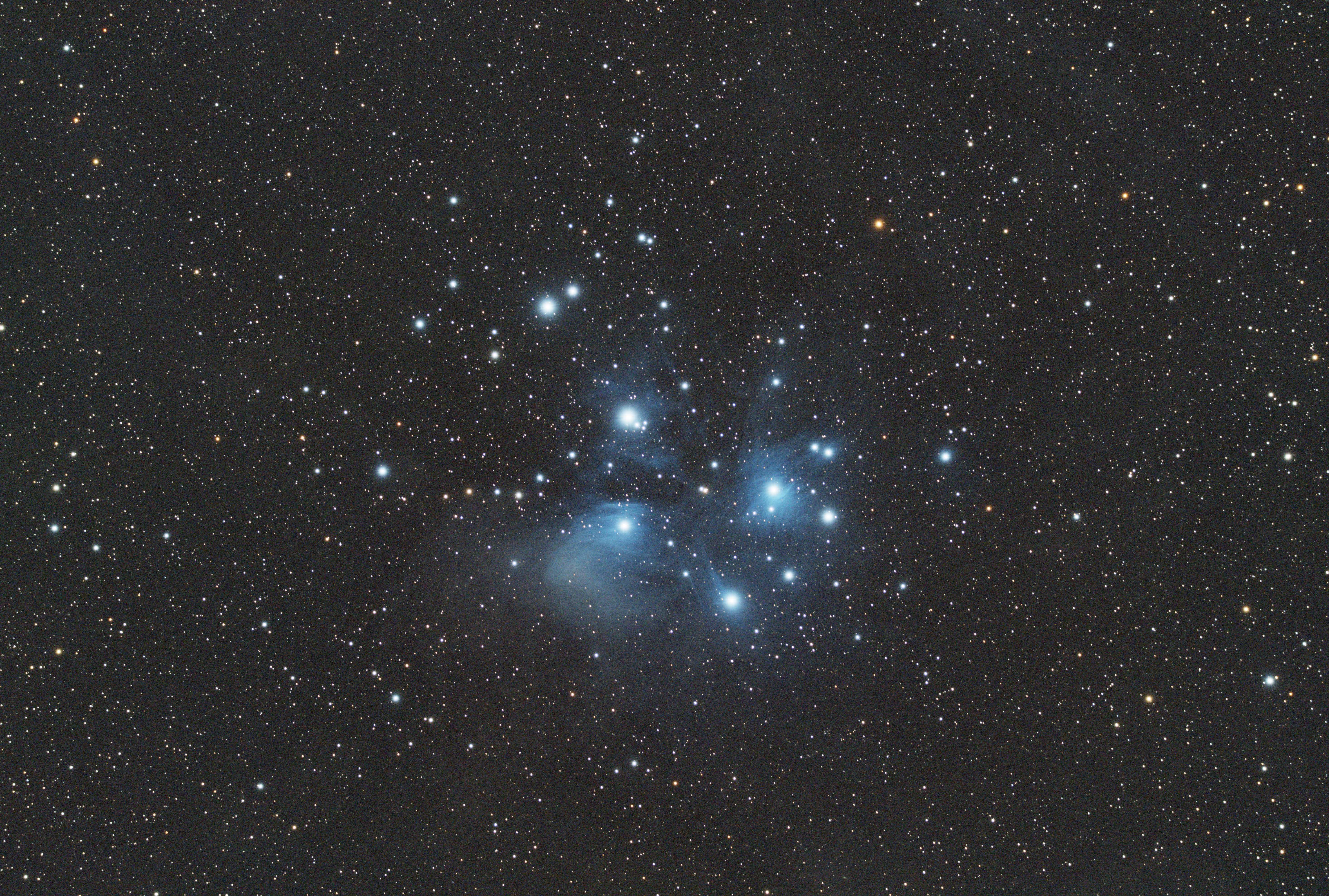
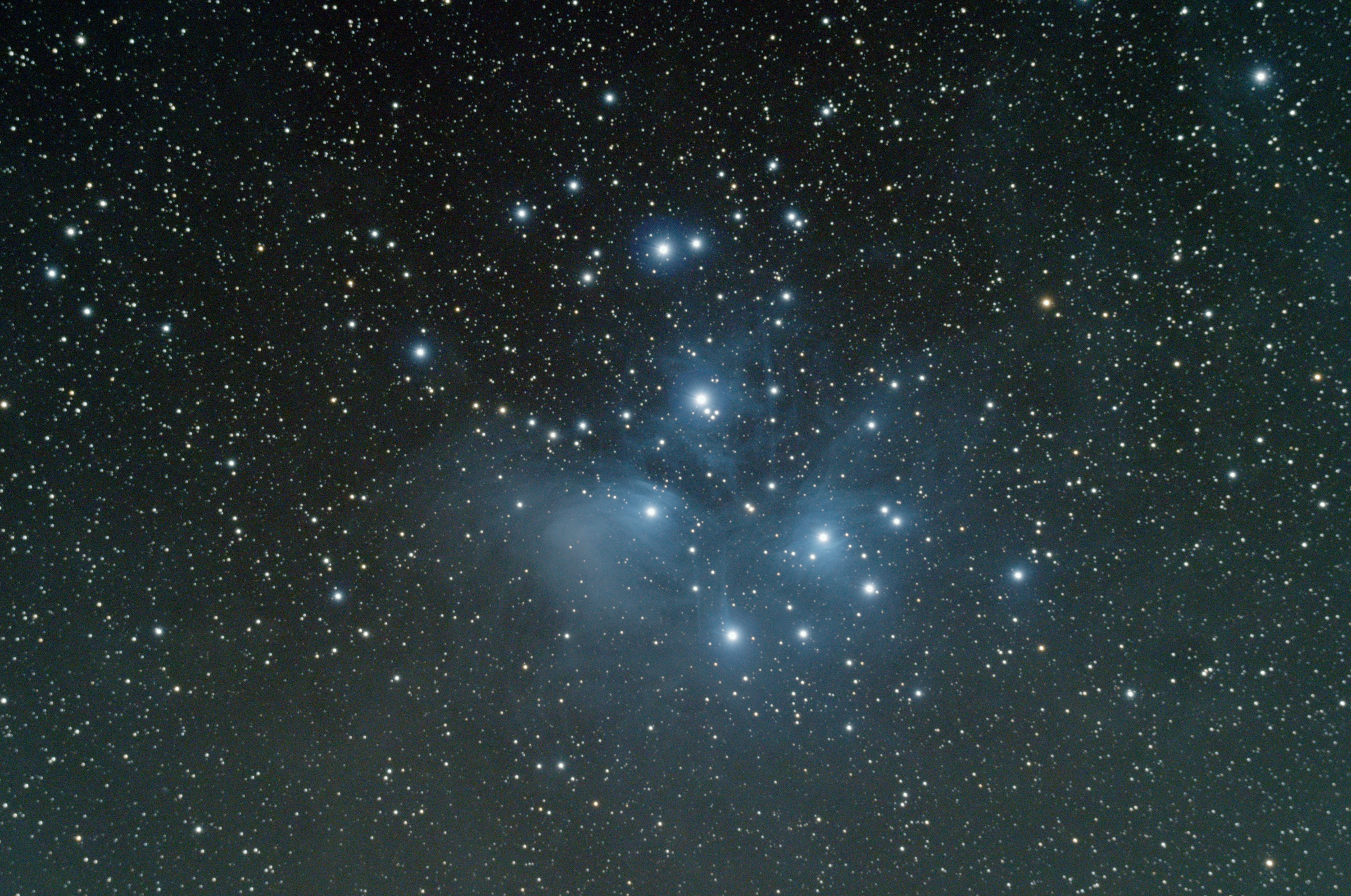
The image was taken via tracking with the ZWO ASI 120mm and with dithering, with bias, darks and flats calibration images. For post-processing I’ve used Gimp software and for acquisition I used Astroberry on a RaspberryPI 4. Really happy with the automation system that I have, which allows me to stay in the warmth of my house during these cold winter nights. The William Optics GT71 it really starts to prove its high quality and its aperture for this kind of DSO.
You can also download the full size high resolution image . Download (119 MB)
The lack of Moon illumination really helped me this time to capture the details in such a short time frame.